
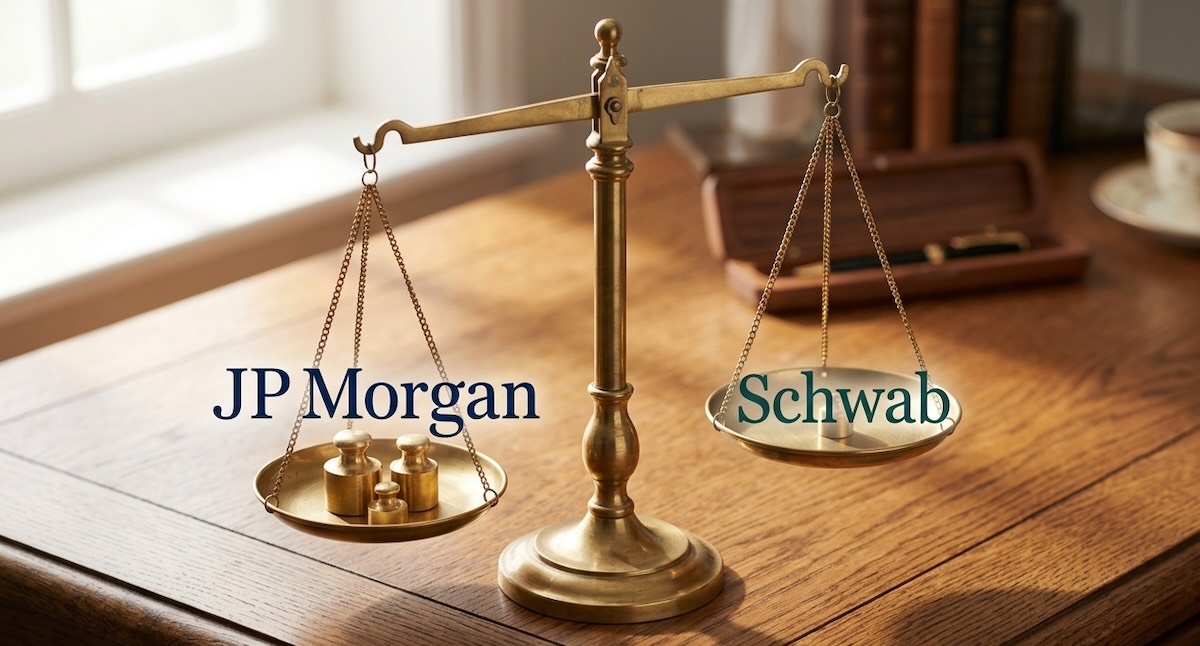
SCHD vs JEPI: Which ETF Is Better for Retirement Income?
By Adam Hyde — income investing tool builder with 25 years in finance and technology.
SCHD and JEPI are two very different ETFs that both carry the “income” label — but they deliver that income in fundamentally different ways. One is built to grow your income over time. The other is built to pay you as much as possible right now. For retirement investors, that distinction matters more than almost anything else about these funds.
The real question isn’t which ETF has a better yield. It’s: do you need income today, or income that grows?
This article breaks down how each fund works, puts them side by side using verified data, and gives you a practical framework for deciding which one — or what combination — fits your retirement stage.
What Is SCHD?
SCHD — the Schwab U.S. Dividend Equity ETF — tracks the Dow Jones U.S. Dividend 100 Index. It holds roughly 100 high-quality US dividend-paying stocks, screened for dividend growth history, financial strength, and yield consistency. Think names like Chevron, Coca-Cola, Verizon, and ConocoPhillips.
SCHD is not a high-yield fund. Its current yield sits at approximately 3.7%, which means $250,000 invested generates roughly $759/month in distributions. That’s not a number that jumps off the page.
What makes SCHD compelling for retirement planning is what happens over time. The fund has grown its dividend at approximately 10.7% per year over the past five years. At that rate, an income stream that starts at $759/month can roughly double within seven years — without adding a single new dollar to the portfolio.
- Current yield: ~3.7%
- 5-year dividend growth rate: ~10.7% per year
- Expense ratio: 0.06%
- Payment frequency: Quarterly
- 3-year total return: ~13% annualized
- 5-year total return: ~8% annualized
- Assets Under Management (AUM): ~$72 billion
- Fund inception: October 2011 (14+ years of history)
- Beta/Volatilty (lower better): 0.85 vs S&P 500
- Dependability Score: 69.00% (Grade: B-) — Strong tier
Strength: Income that grows year over year. Holdings are financially strong, dividend-tested companies. Over 14 years of track record means the dividend growth history is real and tested through multiple market cycles — including 2020, 2022, and beyond.
Weakness: The starting yield is modest. For a retiree who needs income now, 3.7% may not be enough without drawing down capital. Quarterly payments also require more active cash-flow management than monthly distributions.
What Is JEPI?
JEPI — the JPMorgan Equity Premium Income ETF — is an actively managed covered call fund. It holds a portfolio of lower-volatility S&P 500 stocks and generates additional income by selling call options through Equity Linked Notes (ELNs). The result is a yield roughly double what you’d get from a straight dividend fund.
JEPI’s current yield is approximately 7.5%, which means that same $250,000 generates roughly $1,551/month — more than twice the SCHD figure. Distributions are paid monthly, which many retirees prefer for budgeting purposes.
The catch: those distributions are not fixed. Because JEPI’s income partly comes from option premiums, it fluctuates with market volatility. In a calm, trending-up market, option premiums shrink and distributions fall. In a volatile market, they can spike. Here’s what JEPI actually paid over the past 12 months:
| Month | Distribution Per Share | Change |
|---|---|---|
| March 2026 | $0.3513 | +2.00% |
| February 2026 | $0.3444 | −19.36% |
| January 2026 | $0.4271 | +15.25% |
| December 2025 | $0.3706 | +6.99% |
| November 2025 | $0.3464 | −4.04% |
| October 2025 | $0.3610 | −1.98% |
| September 2025 | $0.3683 | +2.96% |
| August 2025 | $0.3577 | −10.46% |
| July 2025 | $0.3995 | −26.02% |
| June 2025 | $0.5400 | +10.68% |
| May 2025 | $0.4879 | +19.61% |
| April 2025 | $0.4079 | — |
The high was $0.54/share in June 2025. The low was $0.3444/share in February 2026 — a swing of over 36%. For a retiree trying to budget predictable monthly expenses, that variability is worth understanding before committing.
- Current yield: ~7.5% (trailing 12-month average ~8.5%)
- Payment frequency: Monthly
- Expense ratio: 0.35%
- 3-year total return: ~10% annualized
- 5-year total return: ~8% annualized
- Assets Under Management (AUM): ~$44.58 billion
- Fund inception: May 2020 (5.8 years of history)
- Beta/Volatility(lower better): 0.58 vs S&P 500
- Dependability Score: 63.05% (Grade: C) — Moderate tier
Strength: High starting income, monthly payments, and notably lower volatility than a pure equity fund. JEPI’s beta of 0.58 means it moves roughly 42% less than the broader market — an important buffer for retirees who can’t afford large drawdowns early in retirement.
Weakness: Distributions vary month to month. Growth potential is capped by the covered call strategy. Management Expense Ratio is significantly higher than SCHD. At just under 6 years old, JEPI has not yet been tested through a full market cycle — its 2023 to 2025 performance was promising, but the long-term record is still being written.
Head-to-Head Comparison
Here’s how the two funds stack up across the metrics that matter most for retirement income investors:
| Metric | SCHD | JEPI |
|---|---|---|
| Current Yield | ~3.7% | ~7.5% |
| Payment Frequency | Quarterly | Monthly |
| Expense Ratio | 0.06% | 0.35% |
| 3-Year Total Return | ~13% annualized | ~10% annualized |
| 5-Year Total Return | ~8% annualized | ~8% annualized |
| Dividend Growth | ~10.7%/year (5-yr) | Variable — no growth trend |
| Income Predictability | High | Moderate (varies with volatility) |
| Beta (Volatility) | 0.85 vs S&P 500 | 0.58 vs S&P 500 |
| AUM | ~$72 billion | ~$44.58 billion |
| Fund Inception | October 2011 | May 2020 |
| Dependability Score | 69.00% (B-) — Strong | 63.05% (C) — Moderate |
| US/Canada Availability | US-listed | US-listed |
Income now vs income later. At $250,000 invested, SCHD produces roughly $759/month. JEPI produces roughly $1,551/month. For someone living off their portfolio today, that $792/month difference is real money. But SCHD’s dividend has been growing at ~10.7%/year — which means in 7–8 years, today’s SCHD income could exceed JEPI’s current payout, assuming JEPI’s yield doesn’t change.
Growth potential. SCHD has historically compounded its dividend meaningfully. JEPI’s distributions fluctuate with market volatility and option premiums — there is no underlying growth engine pushing income higher over time.
Volatility and downside protection. This is where JEPI’s design shows a genuine advantage. With a beta of 0.58, JEPI moves significantly less than the broader market in both directions. SCHD’s beta of 0.85 is also below the market, but JEPI’s lower sensitivity to market swings can meaningfully reduce the portfolio drawdown retirees experience during volatile periods. For someone in the early years of drawing down a portfolio, that stability has real value.
Track record. SCHD was launched in October 2011 — it has 14+ years of history that includes the 2015 correction, 2020 crash, and 2022 bear market. JEPI launched in May 2020, so its real-world record is just under 6 years. It performed well in 2022’s bear market, but its full-cycle history is still limited compared to SCHD’s.
Dependability Score. Scored across 13 factors on the Dependable Income Investing platform, SCHD earns a Dependability Score of 69.00% (Grade: B-), placing it in the Strong tier of rated funds. JEPI scores 63.05% (Grade: C), placing it in the Moderate tier. The gap is driven largely by SCHD’s superior yield stability rating, and lower risk. For retirees who prize income you can count on year after year, that difference matters.
Tax treatment. SCHD dividends are generally qualified dividends, which receive preferential tax rates in the US. JEPI’s income includes option premium income from ELNs, which is typically taxed as ordinary income at your marginal rate — a meaningful difference if you hold JEPI in a non-registered (taxable) account. This is not tax advice — consult a qualified tax professional for guidance on your specific situation.
See the side-by-side breakdown — SCHD vs JEPI detailed comparison →
Which One Is Right for You?
The answer depends almost entirely on where you are in your retirement journey. There is no universally correct choice — only the right fit for your current income stage. SCHD is more defensive and less technology heavy so it may not do as well in a technolgy driven bull market. JEPI did better 2023 to 2025, but lately with market uncertainty, SCHD has had much better performance. A combination of both might be the safest bet.
Early pre-retirees (10+ years from retirement). SCHD is likely the stronger choice here. Dividend growth compounding over a decade-plus can turn a modest starting yield into meaningful income by the time you need it. SCHD’s lower fee also compounds in your favour over long periods.
At or near retirement (0–5 years out). A blend of both is worth considering — SCHD for income growth, JEPI to close the gap on current income needs. A 50/50 split blends the two philosophies and produces a current yield in the 5.5% range, roughly $1,146/month on $250,000.
Already retired and need income now. JEPI’s higher current yield is more practical for retirees drawing on their portfolio today. Just go in with clear eyes about distribution variability — build a cash buffer so a low month from JEPI doesn’t force an urgent decision.
Canadian investors. Both SCHD and JEPI are US-listed ETFs. Canadian investors should be aware of currency exposure (USD distributions) and the 15% US withholding tax on distributions. RRSP accounts are generally exempt from this withholding tax under the Canada-US tax treaty. TFSA accounts are not — the withholding tax still applies to US-listed holdings in a TFSA. This is an important consideration for Canadian retirees building income in registered accounts.
Want the full fund review for JEPI and SCHD? View fund reviews →
How to Compare Them Side-by-Side
The comparison table above gives you the headline numbers — but the real decision comes down to whether a fund’s income is dependable, not just high. A 7.5% yield that gets cut 30% in a volatile quarter is a different proposition than a 3.7% yield that’s grown every year for a decade.
The Dependable Income Investing platform scores both funds across 6 factors — including Yield Stability, Yield, Volatility, Capital History, Fund Risk, and Underlying Assets — and produces a single Dependability Score for each. SCHD’s score of 69.00% (B-) places it in the Strong tier; JEPI’s 63.05% (C) lands in the Moderate tier. You can dig into what’s behind each score, see how both funds performed across 13 dimensions, and run a portfolio income estimate for your own investment size.
The full SCHD vs JEPI comparison is available in the App: View the detailed SCHD vs JEPI comparison →
The Bottom Line
JEPI gives you more income right now. SCHD gives you income that grows. Neither is wrong — they solve different problems for investors at different stages.
If you’re already retired and cash flow is tight, JEPI’s higher yield and monthly payments are genuinely useful. If you’re still accumulating or have time before you need to draw heavily on your portfolio, SCHD’s dividend growth engine may be the better long-term asset.
For many retirees, the real answer is a blend — using each fund for what it does best.
Not sure which income fund fits your retirement plan? Use the free comparison tool to run a side-by-side analysis. Start comparing →
Frequently Asked Questions
Q: Is SCHD or JEPI better for retirement income?
A: It depends on when you need the income. JEPI pays roughly double SCHD’s current yield (~7.5% vs ~3.7%), making it more useful for retirees drawing on their portfolio today. SCHD grows its dividend at ~10.7%/year, making it more valuable for pre-retirees building toward future income. Many retirees hold both.
Q: What is the main difference between SCHD and JEPI?
A: SCHD is a dividend growth ETF — it holds financially strong dividend-paying stocks and aims to grow its distributions over time. JEPI is a covered call ETF — it generates extra income by selling call options on S&P 500 stocks, which produces a higher current yield but caps upside and results in variable monthly distributions.
Q: Does JEPI’s distribution change every month?
A: Yes. JEPI pays monthly, but the amount varies because part of its income comes from options premiums, which fluctuate with market volatility. Over the past 12 months, JEPI’s monthly distribution ranged from a low of $0.3444/share to a high of $0.5400/share — a swing of over 36%. Retirees budgeting around this income should account for that variability.
Q: Is SCHD or JEPI more tax-efficient?
A: SCHD generally pays qualified dividends, which are taxed at lower rates in the US. JEPI’s income includes option premium income from Equity Linked Notes (ELNs), which is typically taxed as ordinary income at your marginal rate. For investors with taxable accounts, this difference can be meaningful. Our free Smart Investor’s Guide to Tax-Optimized Wealth Building covers which account type fits each fund. Consult a tax professional for advice specific to your situation.
Q: Can Canadian investors hold SCHD and JEPI?
A: Yes, both are US-listed ETFs available to Canadian investors through most brokerages. However, Canadian investors should be aware of USD currency exposure and the 15% US withholding tax on distributions. RRSP accounts are exempt from this withholding tax under the Canada-US tax treaty; TFSA accounts are not. This makes RRSP a more tax-efficient home for US-listed income ETFs like SCHD and JEPI for Canadian investors. See our free Smart Investor’s Guide to Tax-Optimized Wealth Building for the full US and Canadian account placement playbook.
Q: What return has SCHD delivered compared to JEPI?
A: Over three years, SCHD has returned approximately 13% annualized versus JEPI’s approximately 10% annualized — a meaningful gap driven by SCHD’s stronger recent capital appreciation. Over five years, both funds have returned approximately 8% annualized on a total return basis. SCHD has the longer track record; JEPI launched in May 2020.
Q: What are the Dependability Scores for SCHD and JEPI?
A: Scored across 6 factors by the Dependable Income Investing platform, SCHD earns a Dependability Score of 69.00% (Grade: B-), placing it in the Strong tier among rated income funds. JEPI scores 63.05% (Grade: C), landing in the Moderate tier. SCHD’s stronger score reflects its superior yield stability, lower risk and simpler underlying assets. The breakdown is available at dependableincomeinvesting.com/compare/schd-vs-jepi/.
Try Dependable Income Investing free
The platform scores SCHD, JEPI, and 100+ other income funds across 13 factors — so you can see at a glance which fund’s income is truly dependable for your retirement stage, not just which one has the highest headline yield. SCHD scores 69.00% (B-) and JEPI scores 63.05% (C) — see the full breakdown behind those numbers.
View the SCHD vs JEPI comparison →
Start analyzing fund performance for free →
This article is for educational purposes only and does not constitute financial or investment advice. Always do your own research or consult a qualified financial advisor before making investment decisions. Yield, performance and other fund attributes are based on data current as of March 2026 and are subject to change.